
rapidscale logo

THE TALENT GAP: Why cloud and AI investments aren't delivering

Inside the execution breakdown slowing cloud and AI returns

Organizations feel ready to modernize with AI, but execution tells a different story

Cloud, AI, and automation are accelerating fast. Skills and talent aren’t keeping pace.

RapidScale’s first annual AI talent and skills gap survey of 250+ US-based IT professionals exposes a clear disconnect between leadership confidence and frontline reality:

IT leaders’ confidence outpaces reality

Confidence in cloud readiness varies sharply by role. While 97% of executives say their teams are prepared to execute their cloud strategy, that confidence drops to 75% among team-level managers and 72% among technical contributors.

While this still represents a majority, the 20-plus percentage-point difference reveals a significant disconnect between those setting strategy and those closest to the frontline—where complexity, constraints, and skills gaps are felt most acutely.

AI readiness shows a similar pattern. Leaders see the roadmap, budgets, and long-term intent. Managers and practitioners live the day-to-day reality of implementation, giving them a more grounded view of actual capability, readiness, and progress.
talent gap statistics

Future-forward skills are the biggest gap in IT

The skills IT will need most tomorrow are missing today. When asked to rate their proficiency across eight core capability areas, IT practitioners ranked application modernization and AI/ML integration at the bottom—making them two of the least developed skills in today’s IT organizations.

The consequences are already visible.

Talent and skill constraints are delaying an average of 32% of IT projects, putting innovation, speed, and growth at risk.

Respondents point to these three primary drivers behind the gap: 

62%

Rising IT complexity: Platforms, tools, and features are evolving faster than teams can keep pace


56%

Limited time to upskill: Day-to-day firefighting leaves little room for meaningful training.


41%

Hiring constraints: A shallow talent pool, headcount limitations, and fierce competition make gaps even harder to fill

How organizations are trying to close the talent gap

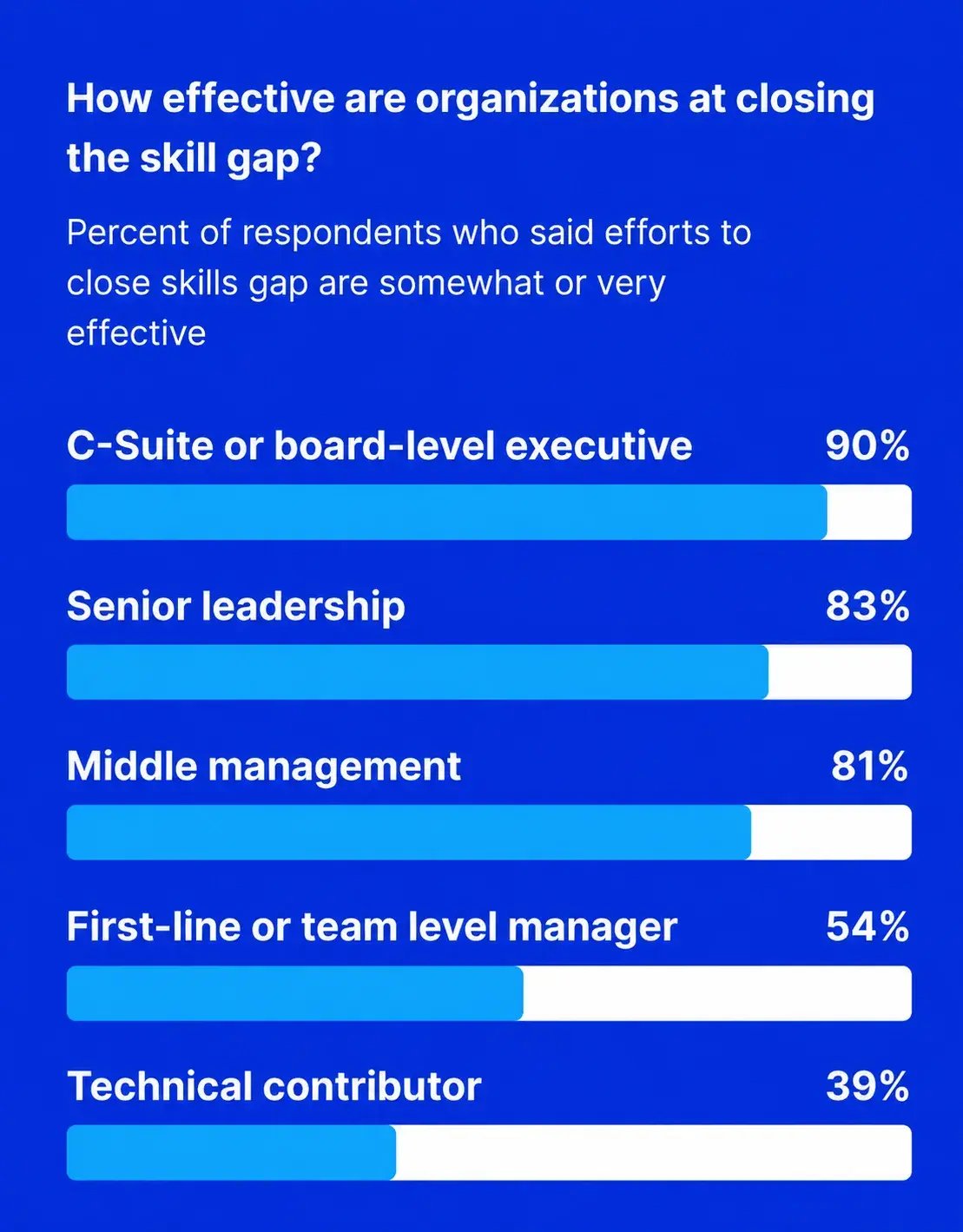
Most organizations recognize the severity of today’s skills shortages and are taking action. Respondents are upskilling or training existing employees (69%), investing in better tools, automation, or AI (68%), and launching mentorship or internal knowledge sharing programs (55%). 

Still, a common theme emerges: 

97% of C-suite or board-level executives somewhat or strongly believe that leadership provides the resources and training needed to close the skills gap. Only 53% of technical contributors agree. 

Organizations often focus on upskilling before hiring, but building from within can only go so far. When multiple teams lack specialized skills, hiring or outsourcing becomes necessary. Many organizations, however, are struggling to find the right talent. 

To close the talent and skills gap, organizations are taking a range of approaches:

69%

Upskilling or training existing employees


68%

Better tools, automation, or AI


55%

Mentorship or internal knowledge sharing


40%

Managed services providers or partners

Notably, only 40% use managed service providers to close talent and skills gaps; yet those who do are more likely to focus on advanced capabilities like app modernization and cloud migration

The gap is growing, and the stakes are rising

70% of respondents say that AI and automation will change the skills teams need to a significant or extreme degree. That shift is already reflected in the capabilities respondents expect to matter most in the near future: 

  • AI/machine learning literacy and implementation
  • Cybersecurity and zero-trust architecture
  • Cloud architecture and platform engineering
  • AI governance, risk, and compliance
  • Automation and orchestration
Blog Image-78

Modern IT environments are becoming more complex, and teams are being asked to evolve faster than ever.

In addition to maintaining infrastructure, teams need to embrace AI, adopt heightened security measures, and increase automation and orchestration—all without causing disruption or introducing unnecessary risk.

talentgap_people

7 practical ways to close the talent gap

Despite the upskilling and hiring challenges organizations face, there are clear ways to close the gap by prioritizing continuous learning and rethinking how teams operate.
A few strategies worth considering include: 

  1. Creating time and incentives for learning
  2. Combining internal development with external expertise
  3. Listening to frontline employees
  4. Building knowledge-sharing systems
  5. Prioritizing long-term needs
  6. Simplifying tech stacks
  7. Rethinking workforce planning

Preparing for what’s next starts now

Change has always been part of IT. New technologies emerge fast, priorities shift, and teams are expected to respond without missing a beat. While no one can predict the next wave with certainty, one thing is clear: the skills required to keep pace will continue to evolve.  

Today, AI, automation, and cloud migration are raising the bar. IT leaders are under pressure to modernize quickly, deliver measurable outcomes, and future‑proof their organizations. But progress stalls without the right mix of skills, experience, and execution power behind it.  

Closing the talent and skills gap is possible; it just takes deliberate action. Organizations that plan ahead and lean on trusted partners can meet today’s demands while building the resilience and capability needed for what’s next. 
campaign_ad


Have questions? Talk to a RapidScale expert

No vaporware. No noise.
Just substance.

We believe technology should create clarity, not complexity. That’s why we focus on doing it right every time.

We challenge the status quo, demand more from technology, and help our clients move forward with confidence. The result isn’t just resilience; it’s momentum.

With RapidScale, you don’t just adapt to change. 
You master growth.  


© 2026 RapidScale | All Rights Reserved
301 Hillsborough St, Suite 1300, Raleigh, NC 27603

Privacy Policy | Acceptable Use Policy