
Keep the momentum going. Explore more insights to move your business forward.
Artificial intelligence is the number one topic in C-suite conversations worldwide today. This isn’t just a technology trend; it’s a business imperative that executives feel they must address. But turning ambition into measurable value requires a clear AI strategy, one that balances innovation with governance and delivers a tangible AI ROI framework for sustainable growth.
This brief examines how leaders can navigate various complexities, such as balancing market pressure with operational readiness, funding innovation without overspending, managing risk without stifling progress, and securing early wins that build momentum for longer-term transformation.
The sections that follow unpack these themes, starting with the widening gap between AI hype and enterprise reality.
Key takeaways:
- Cut through the AI hype and make disciplined, ROI-driven decisions.
- Prioritize data readiness and integration over flashy AI models.
- Fund AI with savings (optimize cloud spend, automation, vendor consolidation) before allocating any new funding.
- Implement governance essentials (privacy, security, lineage) without slowing momentum.
- Achieve quick, measurable wins through focused 90–day projects that build momentum and demonstrate value.
- See lower costs, higher productivity, improved service metrics, and stronger AI governance within 12 months.
Market Pressure: AI Hype vs. Reality
Let’s review the current state of AI “on the ground.”
External Pressures Driving Adoption
External pressures have intensified dramatically over the past year. Board members have seen the impact of AI in other industries and are demanding clear AI strategies from their executive teams.
“What’s our AI plan?” is now as common a boardroom question as asking about quarterly earnings.
Investors have developed a Pavlovian response to AI announcements, rewarding companies that show AI adoption with higher valuations and punishing those seen as lagging. This investor behavior creates a powerful incentive for executives to position their company as an AI leader, regardless of their actual readiness.
Competitive Pressure Points
Competitive signals amplify the sense of urgency. When industry rivals announce AI initiatives—whether real or rebranded old tech—it creates anxiety among leadership teams, who fear being left behind.
Industry analysts and consulting firms add to the pressure by:
- Publishing rankings that compare companies’ AI capabilities
- Creating visible scorecards that compel executives to show improvement
- Developing “AI maturity models” that highlight organizational gaps
Internal Reality Check
For many companies still recovering from the post-pandemic economic hit, budget constraints are the biggest barrier to AI implementation.
The tech infrastructure required to support advanced AI systems demands significant investment in tech and talent at a time when many organizations are being asked to show fiscal discipline.
Organizational Readiness Gaps
This internal hurdle goes beyond budget constraints:
- Data quality issues plague many enterprise systems.
- Siloed data systems create a barrier to comprehensive AI implementation.
- Talent gaps in key roles prevent AI success.
Early AI adopters have reported mixed results. Some high-profile projects are failing to deliver expected returns or are running into unexpected issues surrounding governance, ethics, and integration with existing systems.
These gaps between hype and reality create a tough balancing act for executives who need to show AI progress while making responsible business decisions.
Funding AI with Savings, Not New Spending
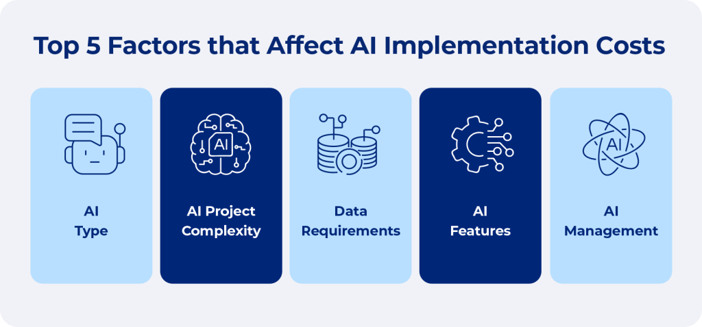 Image of factors that affect AI Implementation costs (Source: Scalefocus)
The challenge of finding the cash to fund AI projects has become a major hurdle for businesses.
Rather than trying to wheedle more money out of the budget, companies need to get creative about finding ways to free up cash to put towards their AI priorities.
This approach forces you to take a hard look at how you're running your current operations and see where you can trim some fat.
Making the Most of the Cloud
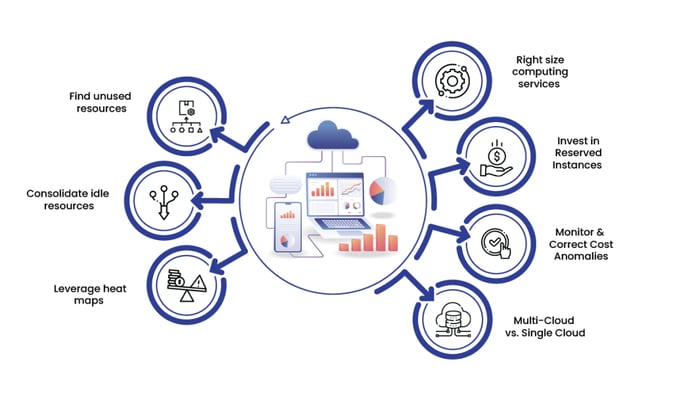 Cloud cost optimization: Strategies, preparation & implementation (Source: Ramotion)
Cloud optimization is a great place to start to tap into some much-needed cash. By adopting FinOps best practices, you can:
- Identify areas of your cloud setup that aren't being used to their fullest potential.
- Downsize your cloud instances so they only get the resources they need.
- Set up auto-scaling policies that adjust your resources on the fly according to your usage patterns.
- Get rid of cloud setup components that are just wasting money, without adding any value.
The dollars you save here can be substantial. In fact, according to McKinsey, mature FinOps programs can cut cloud costs by 20%-30%, freeing up a whole lot of cash to put towards your AI dreams.
Automating to Save Money: A No-Brainer
Another way to fund AI is to automate high-volume, repetitive tasks.
Automation delivers a slew of financial benefits:
- Improved workforce productivity
- Fewer hires required to deal with workloads
- Better operational efficiency
- Fewer errors and less rework
By implementing targeted automation solutions, you can begin to see tangible returns, i.e., savings, which can then be reinvested into AI projects.
Together, these approaches create a ”funding ladder” that organizations can climb to support their AI ambitions. The next step? Making sure you properly oversee these investments.
Risk & Governance Essentials
Implementing AI solutions inevitably introduces new risks that organizations must address through appropriate governance mechanisms. The challenge lies in finding the right balance between establishing sufficient controls for managing risk while maintaining the agility needed to deliver results.
Top Three Governance Essentials
To avoid the pitfalls of AI and ensure optimal ROI, companies must adhere to these governance guidelines:
1. Privacy is your bedrock.
- Define clear data-use limits.
- Manage consent properly.
- Remain compliant with regulations, e.g., GDPR and CCPA.
- Be transparent with data subjects.
2. Security protects both AI systems and their data.
- Lock down development pipelines.
- Monitor for irregularities and prepare response plans.
- Stay alert to AI-specific threats.
3. Data lineage shows where data comes from and how it’s being used.
- Trace data from source to decision to verify quality, reduce bias, prove compliance, and strengthen accountability.
Why Over-Governance Kills Momentum
When governance gets too complex, it often shifts from managing risk to managing paperwork.
Excessive approvals, redundant reviews, and rigid processes slow down innovation, frustrate teams, and create what’s called “governance theater”—the appearance of control without any real impact.
The best organizations avoid this trap by designing just-in-time (JIT) governance controls that are proportionate to the actual risk.
Playbook for Lightweight but Effective Oversight
A streamlined governance model gives you assurance and agility. It should be outcome-focused—not bureaucratic—and embed responsibility into the workflow.
Key elements of an effective AI playbook include:
- AI impact assessment templates: Concise, reusable templates to assess new initiatives without having to reinvent the wheel each time
- Modular governance assets: Pre-approved data usage policies, model documentation templates, and security checklists to simplify compliance
- Continuous monitoring and audits: To measure real-world results, performance, and risk indicators
- Adaptive governance: A “living system” that regularly refines policies and controls based on lessons learned and evolving AI capabilities
This “lightweight but effective” approach keeps you safe while maintaining the speed and flexibility to innovate responsibly.
The 90–Day Win Roadmap
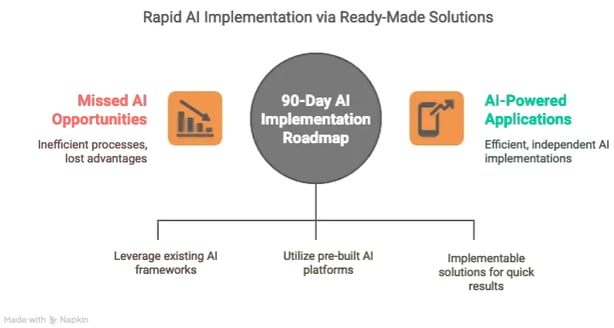 Diagram of 90–day AI roadmap (Source: Kacperwlodarczyk)
Not sure where to start or how to prove value fast?
The 90–day roadmap solves this dilemma by providing a structured, results-focused approach for broader AI initiatives:
- Focus on one high-impact use case that can deliver high impact. Don’t waste time (and money) on trying to achieve an organization-wide AI transformation.
- Choose one clear KPI, like a 30% decrease in error rates, to ensure alignment and focus.
- Follow each phase of the 90–day roadmap:
- Days 1-30: Use case selection and preparation
- Days 31-60: Initial implementation
- Days 61-90: Measurement and refinement
By getting tangible results in a matter of months and continually building on that success, organizations have a solid foundation for applying AI to the rest of their operations and reaping the rewards.
What “Good” Looks Like at 12 Months
After 12 months of plugging away with AI, you should see some pretty concrete improvements:
- Cloud costs are 10%–20% lower thanks to AI being used to spot savings opportunities and get the most out of your existing resources.
- Your workforce has achieved greater productivity with AI; ops, marketing, and data teams can handle twice the volume and complexity without having to add more people to the payroll.
- Improved cost-to-serve metrics because AI is helping streamline everything from customer interactions and transactions to production..
- Stronger governance maturity with documented risk assessments, proactive bias management, and verified data and model controls—all of which include compliance and agility.
AI Strategy for the C-Suite
Implementing AI effectively requires balancing ambition with pragmatism, innovation with governance, and speed with discipline.
In 2025, execution is the key to success with AI. Fund initiatives through your existing budget, using savings from cloud optimization, automation, and vendor consolidation to create sustainable investment patterns that grow with returns.
Governance must be a priority. That means focusing on privacy, security, and data lineage, as well as managing real risks—not stifling innovation. At the same time, deliver quick wins through focused 90–day projects to build momentum, credibility, and capability.
With the guidance above, companies can scale AI responsibly by identifying one measurable, high-impact AI use case and applying disciplined execution. Small, proven wins are the foundation of lasting AI success.
Ready to turn AI strategy into measurable impact? Send our team a message now to assess your organization’s AI readiness and create a roadmap that delivers results.