Keep the momentum going. Explore more insights to move your business forward.
Have you ever wondered how artificial intelligence stacks up against the human brain? As a machine learning architect with a doctorate in neuroscience, I am often asked how artificial intelligence compares to the human brain. Here are a few points of comparison I find interesting. When I was younger, I naively thought that Bots learn from Brains and not the other way around, since bots are a product of our brain and because neuroscience is a much older field than artificial intelligence. It has been amazing how much machine learning has taught us about the human brain; the best way to learn about a system is to try to build an equivalent!
Predictions Machines
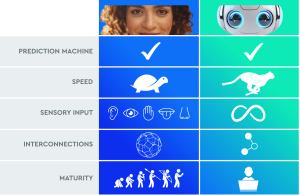
Machine learning systems are often called "prediction machines" because their primary goal is to predict outcomes. I never considered brains as prediction machines, but recent research shows they indeed are.
The brain constructs experiences predictively. Evidence suggests that brains sense the moment-to-moment changes in the world BEFORE sensory inputs hit the brain.
Example: When we are thirsty and drink a glass of water, our thirst is instantly quenched, even though it takes longer for the water to reach the blood stream. What relieves the thirst? prediction that water is going to rebalance the system.
Prediction makes sense because through evolution, a brain that predicts and acts faster has an advantage over a brain that needs to process before acting. Understanding the predictive nature of our brains sets the stage for exploring the fundamental building blocks that make these predictions possible.
Ballpark Base unit Counts |
|
Brains:The base processing unit of a brain is a neuron. Neurons create a massive, interconnected network that functions as a single cohesive unit.
|
Bots:The base processing unit in ML varies based on algorithms. One way to size algorithms is to look at the number of parameters that the system encodes. In machine learning, a 'parameter' refers to a numerical value that defines the model. Parameters can be thought of as the equivalent of synaptic connections in the brain. Example of system size:
|
Note:The brain is still better connected than our biggest LLM today by a factor of 50-200 times. Although models are becoming bigger, a paper from DeepMind, the “Chinchilla Paper”, debunked the concept that "bigger is better" and suggested that many models are over parameterized and undertrained. A higher number of parameters allows the system to encode more information, but model learning relies on the input data size, complexity and modality. Bigger models trained on less data are not optimal. |
|
Training Time |
|
Brains:Modern humans have been on Earth for approximately 200,000 to 300,000 years, during which our brains have evolved and trained. Plus, any brain instance is fine-tuned for the length of the individual's life. We come into the world with a brain template that has been tinkered with for ~300,000 years and we teach it and train it as long as we live. |
Bots:Machine Learning is a fairly new field (~1940s) that benefits from global interest, collective intellect and large funds. It relies on 3 main aspects: computer power, data availability and mathematical algorithms all of which are under intense development. |
Note:Human brains have a 300-thousand-year head start in this race but machine learning benefits from that head start as it is a product of our human intellect. |
|
Speed |
|
Brains:
|
Bots:
|
Note:Computers are a billion times faster than natural intelligence because electrons running through a transistor beat chemicals diffusing in liquid. However, unlike the electrical networks in the computer that propagate the same signal (electrons), neurons use different chemicals that result in different signals. |
|
Input Modalities |
|
Brains:Brains take input from the physical world through the senses. Different animals have different heightened senses. Humans learn most from vision. Vision is the largest human portal in the world. 20 to 50% of the human brain processes vision, depending on how you measure. Dogs and other mammals live in a reality where perception of smell dominates. Bats navigate by sending ultrasound waves and perceiving them as they bounce back. The human input experience is rich but limited. Human ears are deaf to ultrasounds. Human eyes only capture a narrow spectrum of light, and we only taste 5 distinct flavors. Yet, the brain has learnt how to use a combination of these senses in very smart ways. |
Bots:Bots get their input through sensors that can capture different information (passing through data processing). Bots have no limitation in getting different input modalities, however, there is a limitation today on using all these inputs effectively. Most of our advancements have been in natural language processing, other modalities like image and audio have been slower. |
Note:Bots do not have the sensory limitation in input that brains have as they can be augmented with more and more sensory systems. Brains, however, are smarter today in how that input is co-processed for a vivid and holistic experience. |
|
Plasticity |
|
Brains:Human brains are plastic and in constant change. They respond to the environment and rewire based on input. This is what allows us to learn as long as we live. Brain plasticity is highest in children as they learn to control their extremities, walk, talk, learn language and integrate into social reality. |
Bots:Today, machine learning models are static. They update weights (equivalent to synaptic strength) as they train but they do not change the model architecture dynamically. |
Note:Brain plasticity gives the brain an advantage over Machine learning models that focus on parameter updates in a static architecture. The brain's ability to remodel itself in response to environmental changes has arguably allowed humans to withstand the last 300K years and flourish in many environments. |
|
Modularity |
|
Brains:The human brain is modular. Various parts of the brain train to deal with specific senses: vision is processed by the occipital lobe, reasoning by the frontal cortex... Seeing an apple, and recognizing an apple by touch, or by smell, reading the word "apple" and writing the word "apple" are all tasks processed by different systems in the brain. However, the brain works so cohesively that we don't notice the underlying systems until something goes wrong. |
Bots:Machine learning bots have been single-model systems so far, with limited orchestration among a few models. |
Note:To approach human capabilities a machine learning system would likely have to be a collection of optimized systems that work together cohesively with an element of reasoning or preplanning. This sort of idea has started to surface. Example: Dr. Yann Lecun's paper on autonomous ML (see References). |
|
Intelligence Depth & Breadth |
|
Brains:Humans have both broad and deep intelligence. We have a wide understanding of the world and specialization in narrow and deep tasks. |
Bots:Until recently, Machine learning has focused on depth, optimizing specialized tasks per model. More recently with Large Language models, we are seeing an expansion of this single task optimization to multi-task models giving rise to systems that seem to have more general knowledge. |
Note:While machine learning systems are just starting to tackle breadth of knowledge and tasks, very few systems today have both the capability for depth AND breadth exhibited by the human brain. |
|
Reasoning |
|
Brains:Perhaps one of the most "human" capabilities of the brain is to reason and to project us into the future beyond the physical limitations of our body and the constraints of time. Brains of higher primates have a prefrontal cortex that is responsible for decision making, reasoning and complex cognitive behaviors. |
Bots:Most machine learning systems today have little notion of "reasoning". Many are still greedy algorithms that optimize tasks with less preplanning. |
Note:Adding "reasoning" and pre-planning to bots will undoubtedly usher in a new world of capabilities and potential. |
|
Conclusion:
Machine learning bots have enormous potential since they are much faster than we can ever be and have fewer physical limitations than we do. We have had a significant head start for a few hundred thousand years and we benefit from our ability to learn from each other, transfer knowledge and work collectively.
ML has the potential to surpass human capabilities, but it currently falls short due to limitations in multi-modality, depth, breadth, plasticity, reasoning, and other evolutionary advantages our brains possess. The journey of AI is just beginning, and it’s thrilling to imagine what the future holds. I have no doubt that machines will get there someday. The fact remains though that humans are magnificent beings. After all, machines are a product of our own ingenuity!
Written by: Rola Dali
Data, ML and the Cloud | 10x AWS certified | AWS community Builder | AWS Ambassador
Free AI/ML Acceleration WorkshopInterested in exploring how Artificial Intelligence (AI) and Machine Learning (ML) can revolutionize your business? Our free AI/ML Acceleration Workshop is designed to help you:
Don't miss this opportunity to unlock the power of data-driven innovation! Sign up here! |
References:
- “Chinchilla Paper”: Training Compute-Optimal Large Language Models
- 7 And A Half Lessons About The Brain by Lisa Barrett
- Fundamentals: Ten Keys to Reality by Frank Wilczek
- A path towards autonomous machine intelligence, Yann Lecun