
Keep the momentum going. Explore more insights to move your business forward.
When generative AI (GenAI) first came on the scene, adoption speed was the differentiator. Today, as access broadens, companies get an edge through operational maturity (i.e., the ability to deploy GenAI at scale without courting unacceptable risk). While most organizations acknowledge GenAI’s unique risk, only one in three companies has embedded AI responsibility into how AI systems are designed, deployed, and governed.
With this shaky foundation, widespread adoption doesn’t create advantages; it accelerates exposure.
In this blog post, we’ll explore what responsible GenAI means and how organizations can turn it from a policy on paper into an operational capability.
What is “responsible GenAI”?
Responsible GenAI is a framework that embeds operational and ethical safeguards into how GenAI systems are designed, deployed, and operated.
Five core principles define what responsibility looks like for GenAI:
-
Safety ensures outputs don’t cause harm or expose the organization to liability.
-
Fairness requires consistent performance across user groups, avoiding demographic bias in outputs.
-
Transparency establishes when AI is being used and how decisions are made.
-
Accountability assigns clear ownership when outputs fail.
-
Privacy protects sensitive information from inadvertent disclosure through model responses.
These principles aren’t new to enterprise technology, but GenAI raises the stakes considerably. Unlike traditional systems that behave deterministically, GenAI operates probabilistically: The same prompt can produce different responses, and failures often appear as confident fabrications rather than clear code errors. This shift raises the bar for responsible deployment.
To capture GenAI’s benefits without unnecessary risk, organizations need to treat responsible guardrails and governance as engineering concerns, built into systems from day one to ensure trustworthy GenAI scaling.
Why responsible GenAI is now a strategic priority for leaders
In 2025, Deloitte teams delivered strategic reports to Canada, Albania, and other countries based on GenAI-enhanced market analysis. The recommendations were coherent and well-structured—but entirely grounded in hallucinated data. The error wasn’t caught until client teams tried to cross-reference sources that didn’t exist.
Rather than being an anomaly, this pattern repeats across enterprise GenAI adoption: Organizations deploy first, govern later, then scramble when predictable failures surface. Hallucinated content informs major decisions; shadow AI proliferates as employees adopt unauthorized tools; and, when failures escalate to breaches, costs compound quickly.
The distinction isn’t between moving fast and moving responsibly because both can coexist. Guardrails enable production launch; governance sustains performance at scale.
From hallucinations to harm: Turning GenAI risks into responsible metrics
As GenAI adoption accelerates, the volume and variety of failures organizations must anticipate grow in tandem. Three risks dominate the headlines for enterprise deployments:
-
Hallucinations: Models fabricate information by generating plausible but false data, citations, or analysis that can inform flawed business decisions.
-
Bias: Systems produce discriminatory outputs that perform inconsistently across demographic groups, particularly in customer-facing or high-stakes applications.
-
Harmful outputs: Models generate content that violates organizational policy, regulatory requirements, or ethical standards, exposing the organization to legal and reputational risk.
These failures are common, user-facing, and—critically—addressable through systematic controls.
But the GenAI risk landscape extends well beyond these three must-know threats. Models can also leak training data, amplify misinformation, enable social engineering attacks, or produce outputs that infringe on copyrights.
NIST organizes GenAI exposure into 12 distinct categories, ranging from information integrity and dangerous content to cybersecurity vulnerabilities and intellectual property concerns.
Responsible deployment requires organizations to translate these abstract risk categories into measurable operational metrics. How frequently do outputs require human correction? What percentage of responses trigger content filters? Where do models exhibit performance disparities across user demographics?
Organizations that instrument their GenAI systems to answer these questions shift from reactive incident response to proactive risk management.
A defense-in-depth approach to responsible GenAI
Even well-instrumented systems will experience failures when controls are applied in isolation or relied upon too heavily. Responsible GenAI requires defense-in-depth: multiple layers of protection working together to catch failures that individual controls might miss.
This is because no single technique eliminates risk entirely: Input filters can be bypassed through prompt injection, output moderation catches some harmful content but misses context-dependent issues, and human review provides judgment but doesn’t scale to every interaction.
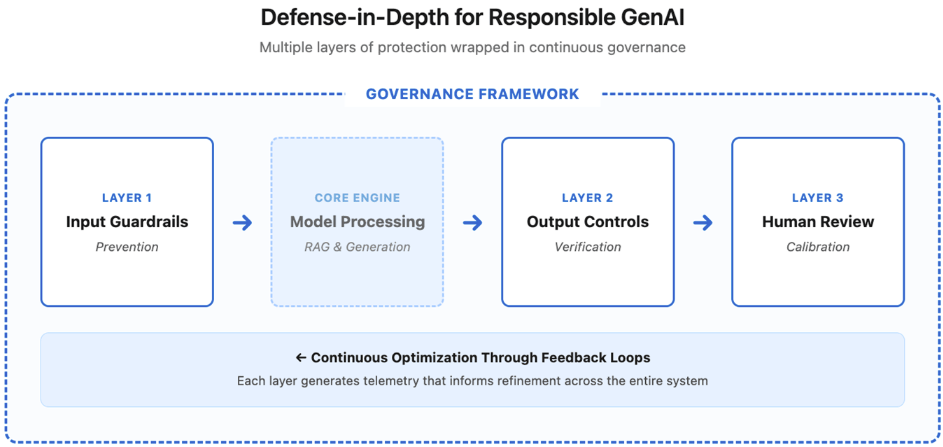
Conceptualized defense-in-depth architecture for responsible GenAI.
The goal then is not to select a single control but to integrate multiple layers into a cohesive system where each mitigates the others’ limitations. Telemetry across layers enables continuous optimization, allowing systems to adapt to real-world use and deliver measurable risk reduction.
While model processing (including RAG and content generation) forms the core system, below we’ll explore the three protective layers organizations control directly: the guardrails that prevent harmful inputs, verify outputs, and calibrate the system for iterative improvement.
Quality in, quality out
Defense-in-depth starts before the first guardrail: with the quality of your underlying data. For RAG systems, accuracy depends entirely on retrieving the right information, and that requires clean, well-structured data with accurate metadata.
Poor data and metadata quality lead to:
-
Retrieval failures that force models to hallucinate rather than ground responses in fact
-
Inconsistent outputs when the metadata doesn’t accurately describe the content
-
Cascading errors that no output filter can catch
Even sophisticated guardrails can’t compensate for unreliable source data. The flip side? When your data foundation is solid, models ground responses in facts, guardrails work as designed, and outputs stay consistent. By treating data governance as a responsible AI practice, you can unlock better accuracy across every layer of defense.
Layer 1: Input guardrails
Input guardrails prevent problematic requests from reaching the model.
-
Prompt filtering identifies and blocks malicious inputs, such as injection attacks attempting to override system instructions, requests for prohibited content, and queries designed to extract training data.
-
Context boundaries define which information models can access, limiting retrieval-augmented generation (RAG) systems to approved data sources and preventing unauthorized disclosure of knowledge.
Implementation relies on validation layers that assess requests before processing. Azure AI Content Safety and Amazon Bedrock Guardrails provide managed services for common filtering patterns.
Organizations with specialized requirements often supplement these with custom validation logic tuned to their risk profile and use cases.
Layer 2: Output controls
Output controls verify generated content before users see it.
Content moderation flags harmful, biased, or policy-violating outputs through automated classification.
RAG grounding ensures factual accuracy by requiring models to cite sources and validate claims against retrieved documents, reducing hallucination risk in knowledge-intensive applications.
Tools like OpenAI’s moderation API offer cost-effective baseline protection, while interactive options like the Azure Responsible AI Dashboard provide deeper analysis, tracking bias metrics and content patterns across deployments.
The goal here isn’t perfect filtering; it’s the systematic reduction of high-risk outputs that reach production.
Layer 3: Human-in-the-loop review
This layer routes high-stakes outputs to human subject matter experts before delivery.
Confidence-based routing automatically escalates responses when the model expresses uncertainty or when the consequences of an error justify manual verification.
Escalation workflows direct outputs to appropriate reviewers based on content type, sensitivity, and domain expertise.
Effective human-in-the-loop systems aim to reduce review volume over time. As models learn from corrections and confidence thresholds improve, fewer outputs require manual intervention, unlocking sustainable oversight.
Beyond guardrails: Building AI governance that scales
While tactical guardrails address immediate risks, governance ensures these controls remain effective as deployments expand across use cases, teams, and geographies.
The need for governance is widely recognized: 77% of organizations are actively developing AI governance programs, yet most struggle to move beyond documentation. The pattern repeats: Policies proliferate on paper while execution falters in practice.
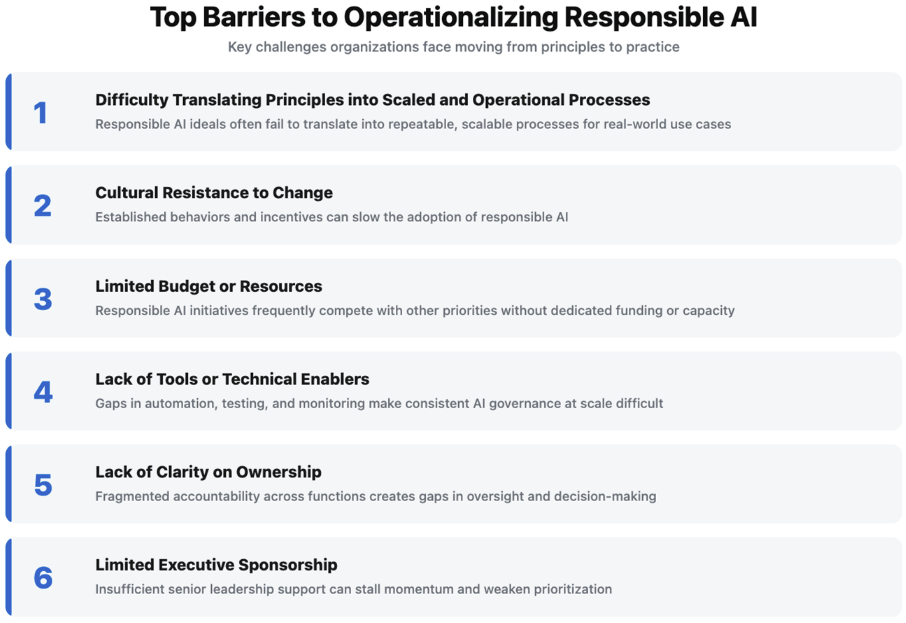
Organizations face six critical challenges when moving from governance policy to operational practice (based on PWC research)
Four governance pillars can help your organization transform intent into operational capability:
-
Centralized oversight establishes who owns AI risk across the organization, removing the distributed accountability that becomes no accountability.
-
Clear responsibility assigns specific teams to model monitoring, incident response, and policy enforcement.
-
Continuous monitoring instruments systems to track performance degradation, bias drift, and emerging failure patterns in production.
-
Framework alignment grounds governance in established standards like NIST’s AI Risk Management Framework and regulatory requirements like the EU AI Act, ensuring programs withstand external scrutiny.
The challenge intensifies as AI agents enter production. Autonomous systems demand governance that operates in real time, not through quarterly reviews. In other words, governance can’t be treated as documentation rather than infrastructure or built around static frameworks and checklists.
Organizations that invest in adaptive governance systems are better positioned to scale AI deployments without taking on unmanaged risk.
Next steps: Turning responsible GenAI into reality
The gap between GenAI ambition and responsible execution closes through deliberate design: guardrails that enable production deployment and governance frameworks that evolve alongside the technology.
Start with three diagnostic questions:
-
Where does your organization stand today?
- Do you have policies on paper or controls in production?
What risks surface in your current deployments? -
Do you have the internal expertise to operationalize governance at scale, or does acceleration require an external partnership?
RapidScale helps organizations put GenAI into production responsibly, bringing expertise in cloud infrastructure, AI deployment, and governance frameworks that scale with your business.
Ready to get started? Send our team a message today for a complimentary Responsible AI Workshop to assess your risk posture and build a governance roadmap.