
Keep the momentum going. Explore more insights to move your business forward.
In today’s enterprise landscape, information is everywhere. But finding the right data at the right time remains a challenge. Employees waste hours each week searching for documents, policies, and insights buried in disconnected systems. Traditional keyword-based search tools often miss the mark, failing to understand context, intent, or nuance.
At RapidScale, we’ve seen this problem firsthand across industries. That’s why we build intelligent search AI agents that transform enterprise search into a conversational, context-aware experience that delivers answers, not just documents.
The problem with traditional search
Enterprise search has long been a pain point. Whether it’s a sales rep looking for the latest pitch deck, a support agent hunting for troubleshooting steps, or a compliance officer verifying policy language, the process is often slow and frustrating.
Why? Because most enterprise search tools rely on keyword matching. They don’t understand synonyms, intent, or the relationships between concepts. They can’t answer questions like:
- “What’s our policy on data retention in Europe?”
- “Who owns the VMware migration project?”
- “What are the key risks in our Q3 strategy?”
Instead, they return a list of documents that may or may not contain the answer, leaving users to sift through pages manually.
The vision: Intelligent, conversational search
Imagine asking a question in natural language and getting a direct, accurate answer – complete with source citations and context. That’s the promise of intelligent search.
By combining semantic search with generative AI, we can build agents that understand what users mean, not just what they type. These agents can:
- Interpret complex queries
- Retrieve relevant content from across the enterprise
- Generate grounded, conversational responses
- Cite sources for transparency and trust
This isn’t science fiction. It’s possible today using AWS technologies like Amazon Kendra and Bedrock.
The architecture: How it works in 3 steps
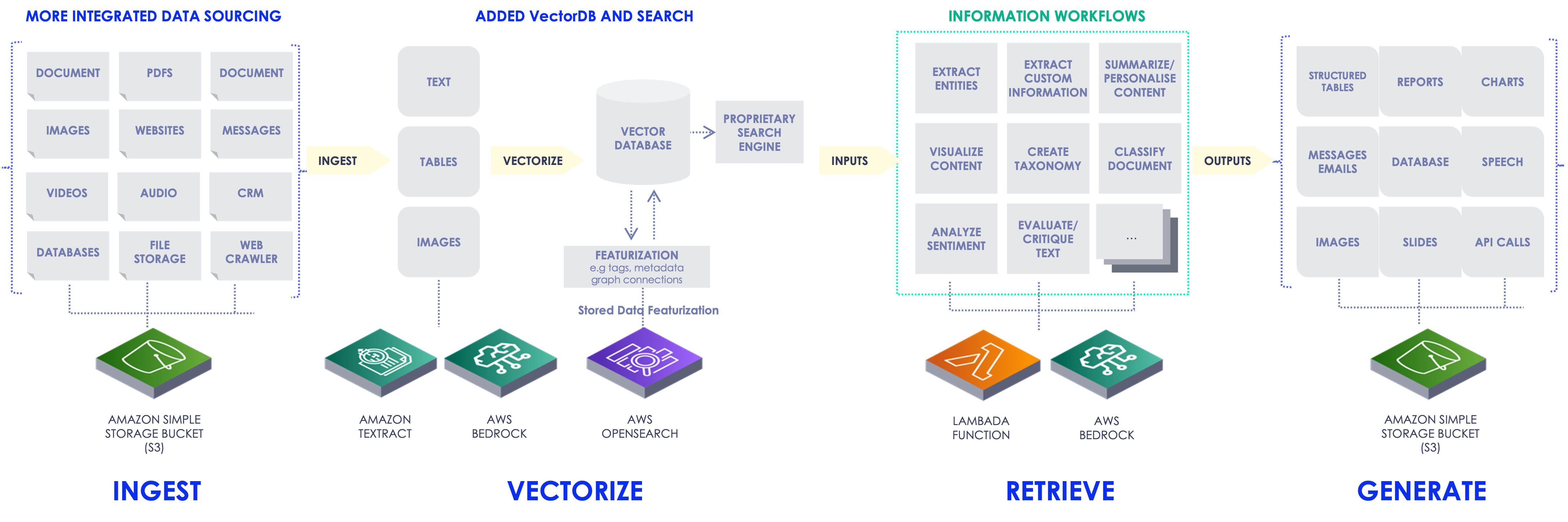
Imagine an intelligent enterprise search assistant designed to help employees find answers – not just documents – across a sprawling landscape of internal data. While the specific technologies may vary, the underlying architecture would likely follow a modular, scalable framework that integrates semantic understanding, data enrichment, and generative AI.
Here’s a high-level conceptual overview of how such a system might be designed.
1. Document ingestion and semantics indexing
The first step involves collecting content from diverse enterprise sources – cloud drives, collaboration platforms, CRM systems, internal wikis, scanned documents, and more. This raw data is then normalized and transformed into a format suitable for semantic indexing.
Instead of relying on keyword matching, the system uses vector-based representations to capture the meaning and context of both documents and queries. This enables the assistant to retrieve relevant information even when the user’s phrasing doesn’t match the original text.
This could involve embedding documents into a semantic space using transformer-based models, allowing for contextual similarity comparisons.
2. Metadata enrichment and preprocessing
To improve retrieval accuracy and model performance, the next step is for the system to enrich the ingested content with metadata like authorship, timestamps, department tags, and document summaries. It might also build lightweight knowledge graphs to represent relationships between entities (like projects, teams, and policies).
This preprocessing layer ensures that the content is clean, structured, and optimized for downstream tasks. It also enables fine-grained access control so that sensitive information is only available to authorized users.
This could be achieved through a combination of NLP pipelines, entity recognition, and rule-based tagging systems.
3. Retrieval-Augmented Generation (RAG)
Finally, when a user submits a query – say, “What’s our policy on remote work in Europe?” – the assistant retrieves the most relevant passages from the indexed content. These passages are then bundled with the query and passed to a generative model.
The model generates a conversational response grounded in the retrieved content, ideally including citations or links to the source documents. This approach balances the creativity of generative AI with the factual grounding of enterprise data.
This could involve a two-stage pipeline: retrieval via semantic search, followed by generation using a large language model fine-tuned for enterprise Q&A.
Use cases: Real-world impact
This architecture isn’t just theoretical. It’s already delivering value across departments and industries. Here are some examples.
1. Internal knowledge discovery
Employees can ask questions like “What’s our onboarding process for remote employees?” or “How do I request a security review?” and get instant answers. No more digging through folders or emailing colleagues.
2. Customer support enablement
Support agents use the assistant to surface troubleshooting guides, SLAs, and onboarding materials. This reduces resolution times and improves customer satisfaction.
3. Compliance and risk management
Legal and compliance teams query regulatory documents and audit trails to ensure alignment with internal policies and external mandates. The assistant helps them stay ahead of audits and avoid costly mistakes.
4. Sales and marketing alignment
Sales reps ask for the latest pitch decks, case studies, or competitive insights. Marketing teams use the assistant to find campaign assets and performance data. Everyone stays aligned and informed.
Why AWS + RapidScale?
RapidScale helps enterprises get AWS right – fast – by modernizing what matters and then running it with Day‑2 excellence. That means you get SRE, FinOps, and MSSP security so your team can ship faster without eroding ROI. When you’re ready to make AI real, our DMaaS makes your data trustworthy and compliant. You get value in weeks, not months.
Scalable and secure
Built on AWS, our solution supports terabyte-scale processing, encryption, and fine-grained access controls. It’s designed for enterprise-grade performance and compliance.
Extendable and future-ready
We avoid vendor lock-in by maintaining ownership of the data and stack. This positions our clients to build private AI agents and workflows over time.
RapidScale’s expertise
As an AWS Generative AI Competency Partner, RapidScale brings deep experience in cloud architecture, data engineering, and AI deployment. We build and operationalize search tools for real business impact.
Our team has helped clients across healthcare, finance, manufacturing, and tech deploy intelligent search assistants that improve productivity, reduce costs, and unlock new insights.
Design considerations: What makes it work
Building an intelligent search assistant is not just about plugging in APIs. It requires thoughtful design across several dimensions.
1. Data quality
Garbage in, garbage out. We work with enterprises to clean, normalize, and enrich their data before indexing. This includes removing duplicates, resolving inconsistencies, and tagging content for relevance.
2. Access control
Not all content should be searchable by everyone. We implement role-based access controls and document-level permissions to ensure privacy and compliance.
3. Prompt engineering
The quality of GenAI responses depends heavily on how prompts are constructed. We use dynamic prompt templates that include context, retrieved passages, and user metadata to guide the model.
4. Feedback loops
We track usage patterns, feedback, and click-through rates to continuously improve the assistant. This includes retraining models, refining prompts, and updating indexes.
Getting started: Your AI journey begins here
Whether you're an IT leader looking to modernize internal search or an engineering team exploring GenAI use cases, intelligent search assistants offer a practical, scalable starting point.
We offer workshops, proof-of-concept builds, and full-scale deployments tailored to your needs. Our team handles everything from data ingestion to model tuning – so you can focus on results.
With semantic search and generative AI, you can empower your teams to find answers, reduce wasted time, improve decision-making, and unlock the full value of your data.
At RapidScale, we’re proud to help organizations evolve their search capabilities and embrace the future of intelligent information access.
Let’s talk about how we can help you build your own intelligent search assistant on AWS with RapidScale. Send a message to our team today to start your journey toward intelligent information access.