Keep the momentum going. Explore more insights to move your business forward.
The vision isn't the problem. Most IT leaders have clear modernization goals: cloud migration, AI integration, app modernization. What they don't always have is the talent to execute them.
That's the IT skills gap, and in 2026, it's quietly derailing more initiatives than anyone wants to admit.
RapidScale surveyed 259 U.S.-based IT professionals and business executives to understand where the gap is widest, what's causing it, and whether current efforts to close it are actually working. The findings are in our latest research report: The Talent Gap: Why Cloud & AI Investments Aren't Delivering.
Here's what we found.
Confidence doesn't equal capability
Every major technology shift generates optimism. We saw it with SaaS. We saw it with public cloud. AI is no different. The opportunity looks obvious. Momentum builds fast.
But momentum without capability stalls.
In our survey, 90% of respondents said they feel ready to execute their cloud strategy. 85% are confident their teams can incorporate AI into key workflows. And yet, 32% report IT project delays tied directly to talent and skills constraints.
Those numbers don't add up. And the reason becomes clear when you look at who's answering the question.
93% of senior leaders feel confident their organization is ready to adopt AI. Only 53% of technical contributors agree.
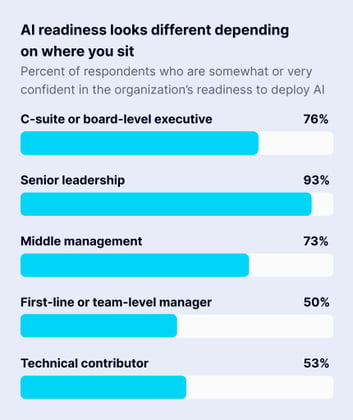 AI readiness looks different depending on where you sit. Source: RapidScale, The Talent Gap: Why Cloud & AI Investments Aren't Delivering.
That gap isn't a communication problem. It's a visibility problem. The closer someone is to actual implementation, the more clearly they see where the foundations are shaky. Leaders see the roadmap. Engineers see what it actually takes to build the road.
When confidence outpaces capability, modernization slows. Initiatives stall. And value goes unrealized quietly, compoundingly, and in ways that don't show up on a strategy deck until it's too late.
Where readiness is falling short
Most organizations report uneven skill distribution across cloud and AI capabilities. Some foundational skills are in decent shape. The advanced skills that define the next phase of modernization—the ones needed for AI operationalization, complex cloud environments, and app modernization—lag well behind.
That imbalance matters. Modernization efforts don't fail all at once. They stall. They slip. They stretch timelines in ways that compound over time and erode the expected value of every investment made to get here.
What's driving it isn't a single issue. Growing environmental complexity tops the list at 62%. Limited time to upskill follows at 56%. A more competitive talent market rounds it out at 41%.
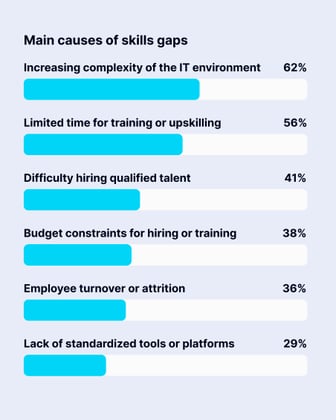 Main causes of skills gaps. Source: RapidScale, The Talent Gap: Why Cloud & AI Investments Aren't Delivering.
None of those are new problems. Which is exactly why they're so persistent.
Confidence is high. Capability is not. Explore RapidScale’s latest research to see how the IT skills gap is quietly stalling cloud and AI initiatives, and what leading organizations are doing differently. Get the report now.
The gap between what leaders think is working and what teams experience
Most organizations aren't sitting still. 69% are investing in upskilling through courses and certification programs. 68% are deploying better tools and automation to reduce manual work. Mentorship and internal knowledge sharing are in the mix too.
Here's the catch: 90% of executives say these efforts are working. Only 39% of technical contributors agree.
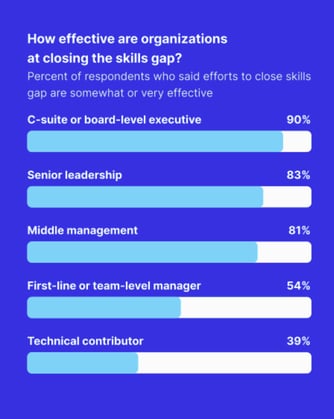 How effective are organizations at closing the skills gap? Source: RapidScale, The Talent Gap: Why Cloud & AI Investments Aren't Delivering.
That's not a rounding error. That's a signal.
Nearly all executives (97%) believe leadership is providing the training and support teams need. Just 53% of technical contributors say that matches their reality.
Internal programs can cover the basics. They don't always keep pace with the complexity of high-stakes cloud and AI initiatives. Fewer than half of respondents work with external consultants (44%) or managed service providers (40%). But the organizations that do bring in outside support are more likely to take on advanced work—app modernization, cloud migration, AI operationalization—and more likely to complete it.
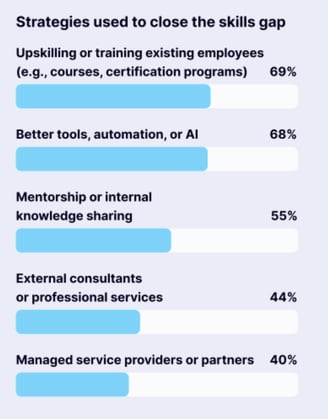 Strategies used to close the skills gap. Source: RapidScale, The Talent Gap: Why Cloud & AI Investments Aren't Delivering.
As the skills gap gets more complex, training alone isn't enough. Teams need the right tools, a credible plan, and partners who've done this before.
Closing the gap before it closes off your options
The IT skills gap isn't a future problem. It's already shaping what teams can and can't deliver today. And for organizations serious about executing on cloud and AI—not just planning for it—the window to close it is shorter than most roadmaps suggest.
The Talent Gap: Why Cloud & AI Investments Aren't Delivering breaks down where readiness is falling short, why common fixes aren't keeping up, and what it actually takes to move from strategy to scale.