
Keep the momentum going. Explore more insights to move your business forward.
When a major cloud platform goes down, the ripple effects are felt across industries. What’s often called a “rare regional disruption” translates into late-night calls, SLA escalations, and lost revenue for hundreds of businesses whose customers don’t care why something stopped working — only that it did.
The recent outage served as yet another reminder that cloud doesn’t equal resilience by default. The biggest takeaway? High availability is not the same as high resilience.
Resilience isn’t a checkbox in the console — it’s a design philosophy. It has to be built into every workload, every service, and every recovery plan from the very beginning.
The recent outage revealed some key gaps in how many organizations are architected today, lessons that can be learned, and practical steps to design infrastructures that can heal themselves before humans even get involved.
1. The Cloud Gives You Tools, Not Guarantees
Today’s leading cloud platforms offer an incredible toolbox for uptime: multiple Availability Zones (AZs), global regions, load balancers, autoscaling groups, managed services, and more. But none of these features automatically assemble themselves into a resilient architecture.
Most enterprises still rely on implicit resilience — the idea that using a managed service or deploying across multiple AZs will automatically prevent downtime. Unfortunately, as the outage showed, dependencies can cascade faster than anyone expects.
We heard of businesses whose databases were in healthy zones, but whose authentication or messaging layers relied on an affected service. Others had auto-scaling policies configured, but health checks tied to a single region. Even advanced observability stacks failed to alert properly when metrics ingestion endpoints stalled.
The lesson: resilience must be explicitly designed and continually validated. The cloud gives you the pieces, but resilience is the blueprint you layer on top.
2. The Real Divide: “Existing” vs. “New” Workloads
At RapidScale, we often categorize our customers’ infrastructure into two camps:
- Existing workloads: Systems that evolved over time, often running on one of the hyperscale platforms for years, with layers of technical debt and limited observability.
- New workloads: Modern SaaS applications, cloud-native services, and greenfield builds that have the chance to “get it right” from the start.
Each camp faces a different challenge.
For existing workloads, the key is modernization without disruption. A Well-Architected Review (WAR) or similar assessment remains one of the most effective exercises for uncovering blind spots—misaligned IAM policies, single-region dependencies, untested backups, or manual DR playbooks that haven’t been touched in years.
For new workloads, the focus shifts to resilient-by-design architecture. This is where engineering teams can bake in self-healing and redundancy early:
- Service mesh patterns to reroute traffic dynamically
- Event-driven automation to restart or replace unhealthy resources
- Multi-region deployments using IaC pipelines
- SLOs and runbooks powered by observability platforms to automate remediation instead of waiting for alerts
Designing resilience early costs a fraction of what it does to retrofit it later.
3. The Outage as a Catalyst for Hybrid Thinking
It’s tempting to think of hybrid cloud as a compliance or cost decision. But lately, we’re seeing it become a resilience strategy.
When any hyperscaler experiences a disruption, having the ability to fail over to an alternate environment, whether another public cloud provider, a managed private cloud, or an on-prem recovery zone, can be the difference between a short hiccup and a full-blown outage.
The organizations that fared best during the recent disruption were those that had cross-cloud redundancy or at least data replication outside the affected region. Their workloads might still have slowed, but their customers never saw downtime.
Hybrid doesn’t have to mean “multi-cloud everything”. For many, it’s about placing revenue-critical apps or customer-facing systems in environments that can seamlessly shift during an outage.
At RapidScale, we call this “managed continuity”, where your architecture knows how to recover itself without waiting for a human war room.
4. Observability Is the Nervous System of Resilience
If resilience is the body, observability is the nervous system.
During an outage, organizations may discover they aren’t as “observable” as they thought. Metrics collection pipelines go dark, alarms fail to trigger, or alerts arrive after the fact. This isn’t a monitoring failure — it is an architectural one.
Resilient systems assume that your monitoring tools can fail, too.
That’s why advanced teams are layering observability platforms, cloud-native services, and custom automation together to achieve multi-channel awareness. For instance:
- Use a platform like Datadog to unify visibility across cloud, Kubernetes, and hybrid environments.
- Set SLOs that track user experience, not just infrastructure health.
- Trigger self-healing workflows (via serverless functions or event-driven orchestration) when those SLOs degrade.
Observability isn’t just about seeing what’s broken — it’s about enabling systems to take action when something breaks.
5. Designing for the Inevitable: Self-Healing Architectures
The holy grail of resilience is self-healing. But what does that mean in practice?
At its core, self-healing means minimizing human intervention when something goes wrong. Instead of waiting for a digital alert and manual triage, your environment:
- Detects an issue (via SLOs or cloud-native monitoring signals)
- Diagnoses contextually (what’s failing, what depends on it)
- Triggers remediation (restart, reroute, replace, or scale)
- Validates success, and escalates only if it fails again
For example, one RapidScale client integrated observability triggers with serverless automation to restart unresponsive containers and automatically open service tickets if remediation didn’t succeed. Another configured cross-region database failover when replication lag exceeded thresholds.
These aren’t futuristic concepts, they’re standard practices for organizations serious about maximizing uptime for revenue-critical apps.
6. Measuring Resilience: From Guesswork to Scorecards
You can’t improve what you don’t measure.
That’s why we built the interactive Cloud Resilience Maturity Scorecard — a simple framework that helps teams benchmark their posture across key dimensions like:
- Architecture reviews and remediation cadence
- DR and redundancy testing
- Observability coverage
- Automation and self-healing maturity
- Leadership alignment on resilience investment
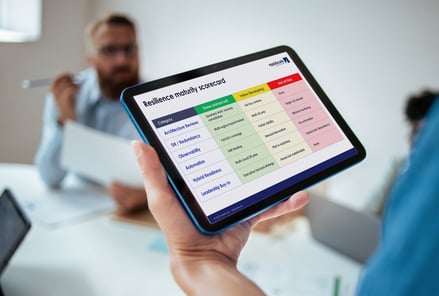
It’s color-coded (Green / Yellow / Red) and straightforward. The goal isn’t to shame, it’s to reveal where a “good enough” cloud setup might still cost hours of downtime if a cloud provider faces an outage.
In fact, when we run the scorecard alongside a Well-Architected Review (or Resilience and Optimization Review), we often uncover patterns:
- Teams with quarterly WARs trend green on redundancy
- Teams with strong observability but no automation linger in yellow
- Teams that rely on manual failover? Almost always red
Resilience is a moving target, and the scorecard helps keep it measurable.
7. Where to Go from Here
This outage won’t be the last. Outages are inevitable — but extended downtime is optional.
Whether you’re maintaining a decade-old monolith application or launching the next SaaS product, the path forward is the same:
- Audit what you have. Run a Resilience and Optimization Review to expose weak points in existing workloads.
- Design for failure. Assume every dependency can break — then automate your recovery path.
- Invest in observability. Use platforms like Datadog, define SLOs, and trigger event-driven workflows that turn visibility into action.
- Plan for hybrid continuity. Even partial replication outside your primary cloud provider can dramatically reduce risk.
- Continuously test. Resilience isn’t static — it’s a lifecycle discipline.
At RapidScale, we’ve helped clients transition from reactive firefighting to proactive resilience planning — reducing downtime incidents by over 40% in some cases. And we didn’t achieve that by selling tools. We did it by changing the way teams think about cloud design itself.
Final Thought: Resilience Is an Engineering Mindset
The cloud has made building fast easy. Now it’s time to make building resilient the default.
The outage proved that even the strongest foundations need reinforcement. But it also showed the opportunity: teams who architect for failure don’t just survive outages;they gain confidence, predictability, and time back for innovation.
Resilience isn’t a product you buy. It’s a discipline you practice. And when it’s done right, it looks a lot like magic: your systems heal themselves, and your customers never notice you were down.