Keep the momentum going. Explore more insights to move your business forward.
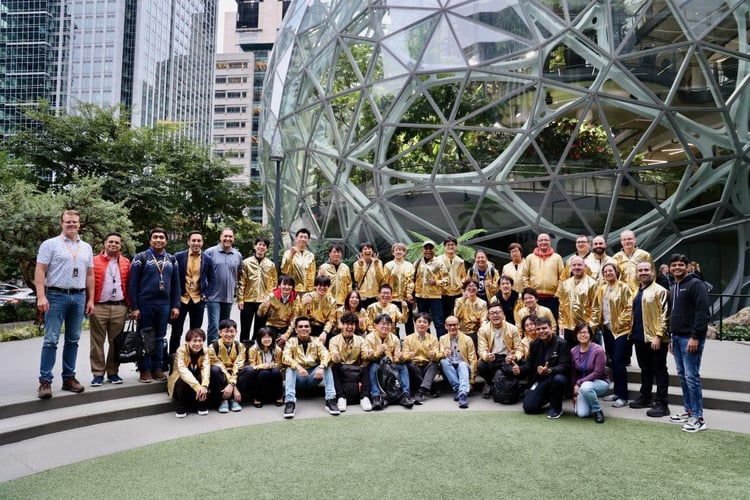
I never set out with the intention of earning an AWS Golden Jacket; in fact, I never imagined I would be where I am today. My journey began as an academic researcher studying the genomics of human brain cancer before I decided to transition into the industry. After starting research in my second year of university, landing summer research internships each year of my undergrad, and completing a seven-year Ph.D. at one of Canada’s top universities on a Vanier Scholarship (a highly selective and prestigious award), I found myself starting over as a Software Developer. The dozen or so awards and scholarships I had earned through over a decade of hard work meant very little in the new world I had just entered.
A Montreal-based company, however, took a chance on me, and I was determined to succeed. At that time, I had little knowledge of the cloud. My background was in genomics research (big data analytics) with a wealth of experience in tooling and automation on high-performance computing clusters and on-premise servers. In academia and research, on-premise computing was the go-to for predictable costs and better security control.
My new role, however, was all about building systems on AWS Cloud, and I quickly realized that cloud computing was a completely different paradigm compared to on-premise or HPC environments. With no formal onboarding or cloud training, I had to spend a lot of time researching to find the right building blocks, understand each service’s limitations, and figure out how to configure and build systems properly. Often, I ended up using suboptimal services when better alternatives existed.
To save time, avoid common mistakes, and proceed more confidently, I knew I needed training in cloud fundamentals. I believe in understanding core principles and theoretical context. Well-structured courses, though theoretical, provide an efficient way to cover concepts. After some research, I decided to pursue my AWS Solutions Architect Certification. Architecture and Cloud were not topics covered in my academic education, so I had to rely on online content creators. I purchased two different courses and spent my evenings diving into this new world after my two little ones went to bed.

I thoroughly enjoyed the AWS Solutions Architect Certification and highly recommend it to anyone interested in cloud. It’s the certification that covers the landscape of the cloud ecosystem, breaking down essential cloud and architectural concepts and exploring key AWS services. After passing the Architect certification, I went for the Developer Certification since I was working on serverless applications daily. Since then, I’ve completed all the AWS certifications—and earned the Golden Jacket!
Would I Recommend Certifications?
Absolutely!
However, it depends on where you are in your career. If you’re a senior cloud architect with significant experience, certifications may not be worth the effort. But if, like me, you’ve made an abrupt career shift, certifications can help you build knowledge and confidence in your new domain. If you’re a junior professional entering the field, certifications are also a valuable way to develop both knowledge and confidence.
I recommend viewing certifications as a structured study path rather than just an exam to pass. Degrees and certifications, in themselves, hold little value beyond the learning experience they offer.
Resources I Used
There are many excellent resources online, both free and paid. Here are a few of my favorites:
- Tutorials Dojo – One of the best resources for AWS certifications, offering practice exams that closely reflect the real ones.
- Stephane Maarek
- Adrian Cantril
- Zeal Vora
- AWS re:invent videos on YouTube
General Impressions
The AWS certification landscape seems to be evolving, with several certifications being retired (AWS Certified Data Analytics, AWS Certified Database, and AWS Certified: SAP on AWS) and others in beta (AWS Certified AI Practitioner, AWS Certified Machine Learning Engineer). I found the associate certifications to be better defined in terms of content than the specialty ones. For instance, two independent preparatory courses for an associate exam are more similar to each other than courses for specialty exams. Additionally, there are more resources available for associate exams. I recommend starting with associate certifications before attempting specialty ones.
Some of the exam questions can be frustrating, as they test very specific integrations or configurations that add little pedagogical value and force memorization. I hope this type of questioning is reduced in future exams.
Having earned certifications across AWS, Azure, and Google Cloud, I find the AWS ecosystem to be the richest in resources and online support. If you’re just starting your cloud journey and haven’t committed to a specific provider, I highly recommend AWS. The quality and quantity of online resources are significantly higher on average.
A Word on Determination
While the Golden Jacket can be seen as a symbol of a broad knowledge base in AWS, what it truly represents to me is determination and focus. Learning concepts across different fields and sitting through multiple 3-hour exams—while working full-time and raising two children under 10—was no small feat. The cost of the Golden Jacket is not in money, but in sweat and tears. It requires commitment, time management, determination, and self-discipline. But if a Middle Eastern woman with two young children can achieve it, anyone can!
Here’s my advice for tackling any challenge:
- Believe in yourself: I believe anything is achievable with enough time and effort. If you feel stuck, you may need more research and support. Remember, if one person can conceive an idea, another can understand it. If you’re struggling with a concept, change your resources—don’t quit the task.
- Pace yourself: Slow and steady progress beats intense, short-lived sprints. The power of compounding is amazing—small, continuous effort adds up over time.
- Know yourself: We all have different strengths and learning styles. Understanding how you learn and what motivates you will help you stay the course. For example, I’m a visual learner, so I prefer videos to reading.
- Seek support: When things get tough, a supportive study buddy or a friend can help you stay motivated during the low points.
- Take defined breaks: If you’re feeling overwhelmed, it’s okay to step away for a set period. Sometimes, a break is the best course of action.
- Define your why: Knowing your reasons for tackling a challenge will help you persevere when the going gets tough. I pursued certifications to quickly catch up on industry knowledge and used them as a coping mechanism during the isolation of the pandemic. I also wanted to prove to myself that I could still achieve my goals after motherhood.
This challenge is now complete. On to the next! Remember: "The journey of a thousand miles begins with a single step." Take that first step and stay the course!